The Locked Drawer

The first chapter of the novel I am working on now, could also stand on its own—as a short story. Its meaning and theme here, are somewhat more general than what will develop in the novel. Here it's more like a song. I am sure you will enjoy it.
--------

He always kept his desk drawer locked.

It's not a crime. Many people do. Some have no reason at all. Look in, and all you will find are staples and rubber bands. Others have a vague one. They keep their cheque book and the odd paper that must be hidden. But a desk drawer is not the place a man should normally keep his valuables or important secrets. It is in plain view and usually easy to break open. The very first place a burglar would visit. No. Important documents, valuables, even petty cash are best kept out of sight—in a hidden safe, or better still, a safety deposit box in a bank vault.

Dad had both. He kept his cheque book, petty cash and his daily valuables in a small safe, somewhere in his bedroom closet. His deeds, stocks and real valuables were in his safety deposit box. I knew exactly what was in each of these two places because I had access to them.

It was the inside of his desk drawer I had never seen.

Down Memory Lane

The Air House was on the south side of the big Van Riebeek Square, next to an eighteenth-century Residency which housed a department of the Ministry of Public Health.
Eric Ambler: The Night-Comers

Right there, in my mind's eye, there was a picture of the big square. It had various buildings all around it and beyond them there were large fields. But why fields? Hadn't I read in the previous paragraph that the square was in the midst of a city of a million and a half? So beyond the square there had to be other buildings, perhaps even plain houses, but no fields. I quickly backtracked to the previous paragraph. Yes, it was just as I had thought. What was going on here? Why was the author saying one thing and I was imagining another? I was under the impression that the author's words set-up a sort of framework on which our imagination builds a picture based on our experiences. But here I had built a picture that was definitely different from the one described. Was my imagination so wild that even the author whose words I was reading couldn't restrain it? Or was I changing the story I was reading to something of my own?

Farley Mowat - Wolves & Whales

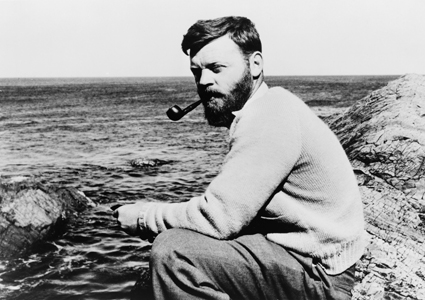
Farley Mowat (1921- ) is Canada's best-selling author and environmentalist. He has published 45 books and sold 17 million copies in over fifty languages. Outside Canada, he is not as well known as compatriot Margaret Atwood. But still, he is the most Canadian of Canadian writers because well, he writes about Canada. In Mowat's stories, Canada is not simply the setting or the background. It forms the foreground. So he is the Canadian author, just as Gordon Lightfoot is the Canadian musician.

He was born in Belleville, Ontario in 1921. He was the only child of Angus Mowat, a writer and librarian, who relocated his family several times in different places across Canada, a practise that Farley was to continue as an adult. As a boy, Farley loved nature and animals, and his room at times resembled a small zoo. His amusing stories The Dog Who Wouldn't Be (1957) and Owls in the Family (1961) vividly recollect that period. Later he joined the war effort and took an active part in the invasion of Sicily and Italy. From his war experiences he later wrote The Regiment (1955) And No Birds Sang (1979). After the war, Mowat studied Biology at the University of Toronto and wrote his first book, People of the Deer (1952). This book singlehandedly exposed the mistreatment of Canada's native people and made Mowat a celebrity overnight. As a result the Canadian government started shipping food to the Caribou Inuit people whose very existence they previously denied.

Eric Ambler & Alfred Hitchcock

Eric Ambler (1909-1998) is the father of the modern thriller novel. He took the pulp thrillers of his day and with appropriate changes wrote thrillers that were in effect, literature. The Mask of Dimitrios (1939) became the first literary thriller and thirty year old Eric Ambler was unanimously accepted as a master of his craft. Alfred Hitchcock (1899-1980) is the father of the film thriller. The MacGuffin, voyerism, suspense and point of view in pure cinematic terms were mostly developed by him. Hitchcock with his fifty odd films, and a successful ten year TV series, was well known but not considered important. It took a frenchman, film director Francois Truffault, and his book Hitchcock (1966), to elevate him to one of the great movie directors of all time.

Joan Harrison (1907-1994) a graduate of Oxford and the Sorbonne was hired as Alfred Hitchcock's secretary in 1933. Soon she read various books and screenplays to help him choose his future projects, and even wrote the screenplays of his films Jamaica Inn (1935), Rebecca (1940), Foreign Correspondent (1940), Suspicion (1941) and Saboteur (1942). In 1958 she married Eric Ambler. She was a major collaborator to Hitchcock's success, and it is hard to imagine that she had no say in Ambler's later novels. But as much as we would find it intriguing to think that it was a woman who pushed the two men to greatness, she wasn't. Ambler had made his fame well before he met Harrison, and she was but one of Hitchcock's collaborators. What united the two men and contributed to their success was not a woman but the concept of an innocent man who is wrongly accused.

Choosing the Storyteller

There are basically three points of view (PoV) in literature:
(a) The first person, where the narrator is one of the characters in the story and speaks directly to the reader. (Example: I liked this girl. “Want to go for a coffee?” I said. She looked away.)
(b) The third person, where the narrator observes the characters in the story and can tell us what one of the characters thinks or feels in any particular scene. (Simon Drake thought that he liked this girl. “Want to go for a coffee? he said. She looked away.)
(c) The omniscient, where the narrator observes the characters in the story and can tell us what each of the characters thinks or feels in all the scenes. (Simon Drake thought that he liked this girl. “Want to go for a coffee? he said. What nerve she thought and looked away.)

Before the author puts the first word on paper he must decide who is going to tell us the story. Will it be God (omniscient), one of the characters (first person), or something in between (third person)? There are advantages and disadvantages in each of the three PoV.

The Wrong Word

That day it was really very hot and humid.

Eric Ambler: The Light Of Day (1962)
describing June 15th in Athens Greece

I have lived in Athens, Greece a large part of my life. Mid June may be hot, and every ten years perhaps even very hot. But it is never humid. In fact, the opposite is true. Visitors are advised to have products that humidify their throats and lips. So while reading the book, a single word was enough for me to stop and think. At that place, in chapter one, the author had lost me. The Light Of Day is one of Eric Ambler's better books. It has won a Gold Dagger Award and it was made into the 1964 heist film Topkapi. And Mr Ambler is perhaps my favourite author. Still with one wrong word he had lost me.

In everyday life, many impossible things actually happen and when we read our newspaper we scarcely doubt that they did. In a novel we know we are reading fiction, and because we know, we must be convinced every moment that what we are told can actually happen. If the author has built his characters from real people he has met, if his characters move in an environment we think is real, if he entertains us sufficiently we forget we are reading fiction and slip into his world. But he must get all the details of the world he has built perfectly right. Remember the word humid--all it takes is one wrong word to stop reading, think, and shut the book.

Literature and Experience

There are three basic uses of language:
(a) To communicate practical and scientific information,
(b) To persuade, as in advertising and propaganda, and
(c) To communicate experience.
Each particular use of language is a combination of these three items.

When language is primarily used to communicate experience, we call it literature.

Experience may be transmitted to us through science and through literature and these two methods are not rival but complimentary. If we are to understand something fully, we really need both. To explain what I mean let me repeat the example given in Laurence Perrine's wonderful book on poetry Sound and Sense.

Let's say you wish to learn about the eagle. You open up an encyclopedia and you see what it looks like, you find out what it eats, how it hunts, how it raises its young. You may also look it up on You Tube and see how it moves. But do you know anything about the soul of an eagle? What about its power and lonely majesty in the wild grandeur of its surroundings? Now read the short poem below:

Good Dialogue is Oblique or Indirect

We all cherish good dialogue. Not only is it easy to read but it can convincingly further the plot and breathe life into the characters. It allows the individual reader to have her personal take on what is happening on stage. And it provides a social life to the reader who is usually reading alone. Dialogue is so easy to read and it's such an effective page turner that the reader altogether misses the most important aspect of good dialogue: It is hard to write.

For example, when I say: Mary is shorter than John, I have written a simple and precise statement. It is also a very dull statement. So, let's put this in dialogue to make it exciting:

Hi Mary.”
I am shorter than you, John.”
Not exciting, is it? Unfortunately most of our real, daily dialogue is of this form, direct question and answer and hence boring. That's why we turn to novels! Good fictional dialogue is interesting because it's “oblique” or “indirect”. In fiction, characters answer questions obliquely or they talk about one thing while the reader understands something else. To say the same thing with oblique or indirect dialogue, I must create a conversation that will in effect cipher my simple statement (“Mary is shorter than John”) in such a way that the reader is sure to decipher it correctly. This deciphering requires intelligence and it's what makes dialogue exciting to the reader. I may write:

Salman Rushdie: Joseph Anton

Joseph Anton: A Memoir is Salman Rushdie's autobiography during (what became known as) the Satanic verses controversy or the Rushdie affair. In short, Rushdie's novel The Satanic Verses (1988) caused violent reactions in the Muslim world and Iran's leader issued a call (fatwa) on all valiant Muslims wherever they may be in the world to kill them (the author, his publishers, editors and translators) without delay, so that no one will dare insult the sacred beliefs of Muslims. What intrigued me to the book was not the political or religious controversy but the thriller aspect: How was Rushdie hidden effectively from his countless pursuers for thirteen years? Were there any near misses? Did he have family and social life during this period? Was he able to work?

Salman Rushdie was born in Bombay, India in 1947 and came from a well-to-do family that had made its fortune in the textile industry. Although a declared atheist, Rushdie studied history and religion at the University of Cambridge. His first novel, Grimus (1975) went by unnoticed, but his second, Midnight's Children (1981) won the Booker's prize in 1981. It was followed by Shame in 1983. Then came The Satanic Verses. Rushdie has said to an interviwer that I expected a few mullahs would be offended, call me names, and then I could defend myself in public... I honestly never expected anything like this. Although it was only a novel, Muslims' response went far beyond gatherings and into violent protests (where several people died), book-store bombings in US and Europe, the killing of the Japanese translator and the near fatal injuries of various others.

Plato's Great...Great Grandchildren

I met Nick last week at a friend's party. We talked about this and that for a while until I noticed that his big smile never left him. At such hard times, how did he manage to keep on smiling?
It's finally official,” he told me. “Seventy years ago, the registrar made a mistake. My real family name is Paleologos, not Paleologou, as we are called.”
Can a single letter make such a big deal?”
A huge one. You see, my family's origin is from a village close to upper Kardamili in Mani. And that's where the brother of the last Emperor of Byzantium hid from the Turks and settled down. The dynasty of Paleologos was the longest in Byzantium. I must be their direct descendant!”

Reader, I am not a young man any more so I have watched myself bleed many times. And even though I don't suffer from colour blindness, I can't be certain if my blood colour is closer to pink than black. There is one thing however I am damn sure of: not once did it appear to be blue. Unlike smiling Nick I have no claims to royalty. But ever since I was in high school, I had this bug inside me. Where did I come from?

The Secret of Good Dialogue

Fictional characters communicate mostly with dialogue to further the plot of a novel. Good dialogue is cherished by intelligent readers because it convinces them that they are observing the story rather than being told by the author. Good dialogue can quickly define characters and further the plot with little or no description. It sounds real--we feel we are there. And yet if we examine how close to reality the aspects of a good novel are, we would discover that although characters and plot may be hugging reality, good dialogue is almost always far away!

Reader, you'd probably think I've gone bananas. You know that most of last century's important writers, people like Hemingway and J D Salinger, listened in on various characters to get things right. So how can good dialogue in fiction be further from reality than both plot and characters? I know it sounds absurd, but it is true. If you want to see this for yourself, take the trouble to record with your cellphone a few everyday conversations. When you play them back, you will discover that they consist mostly of unnecessary words, incomplete sentences, a drifting subject, and echoes of questions or words. Real dialogue lacks interest.

Even if you remove the echoes, rambles and unnecessary words from real dialogue, most readers would still find it boring. Sol Stein, in his masterful Stein on Writing (1995) says that the basic difference between real and fictional dialogue is that real dialogue is “direct” whereas good fictional dialogue is “oblique”. In other words in real conversation we directly answer questions whereas in fiction, characters obliquely answer them to arouse interest.

How to "Create" Characters

An author writes a novel to tell a story but it's the people in the novel that must make the story happen. For example, if a theft is going to take place, one of the characters must be the thief. Most novels have two or three basic characters and perhaps half a dozen secondary ones. So the author must bring into existence thieves and murderers, nuns and adulterers, post-office clerks or bank managers to breathe life into his story. Notice I said “bring into existence” and not “create”. The difference is subtle, but it's what separates the great works of literature from the trash that eventually finds its way to the recycle bin.

Good authors don't create characters. They observe them in every day life and copy them. How else could it be? How would they know how thieves behave and interact with others if they haven't met any? If they created a thief and gave him characteristics that they think a thief should have, readers who have met actual thieves in their lives would not believe in him. Sooner or later word would get around and the book would be forgotten. Authors write fiction but we can only enjoy the story if we feel that the characters are real, if we can believe in them. And if the author has not copied his characters from life but created them, he might as well send them to Mars!

Now reader you probably think that I am putting you on. Isn't everyone saying that authors “create” characters? I mean the first thing we read in any novel, usually under the copyright statement, is that the characters are the product of the author's imagination and that they bear no relation to any living persons. Right? Hogwash!

Body Language in Literature

Body Language is a form of human non-verbal communication accomplished by a series of body postures, facial expressions and eye movements. We subconsciously know if someone is happy or sad, bored or excited, thrilled or sleepy just by looking at him. Even though an estimated 60-90% of all human communication consists of body language (verbal is only about 7%), we were ignorant of this language until the late 1960's when the first course appeared in an American university.

In spite of our academic ignorance, a number of professionals had managed to control their body language on a practical level for specific ends. Good actors for example, took the appropriate body postures and facial expressions to effectively communicate the feelings of the character they portrayed to their audience. Successful salesmen also used body language to gain the trust of their customers. So did swindlers and politicians. A good speaker knew when his audience was bored so that he could change his pace or his subject to reestablish the communication.

PureText and Other Free Goodies

We do it every day. We copy text from a document or a web page and paste it to another document for whatever reason. It's immediately apparent that the copied and the original text's fonts, their size, the line spacing and all the other goodies that determine how text appears on a page are all different. If we wish to incorporate the copied text to our present document form we must correct it. This is not a difficult process but if you do it a number of times you will become exasperated. Years ago you would have ripped the page off your typewriter, crumbled it and threw it into the trashcan. But in this age of computers crumbling laptops could prove awfully expensive. So what do you do?

"PuretText" is a tiny (28 kB!) computer program you may run in your Windows computer. It sits on your task bar. You copy anything you wish from anywhere and click the PT symbol on your task bar. This changes whatever is on your clipboard to pure text. When you now proceed to paste it to where you want it, presto! It immediately matches the form of the rest of your document. Life is good again. And like most good things in life, PureText is free (without any small print, advertising or what have you). Just visit the PureText home page above to learn to use it and download.

The Mechanics of Good Dialogue

I once took my car to an insurance evaluator. He walked around it in semi-darkness and immediately told me all the details of every collision I had been involved in. He knew exactly what to look for and how to interpret it.

In the same way you can open a novel in a random page, look at the dialogue, and say with some certitude how well the particular author handles dialogue without even reading the dialogue itself. Good dialogue in a novel can easily be distinguished by its mechanics. Here are three things you have to look for to spot bad dialogue:

a) The emotions of characters are described.
Does the author find it necessary to tell you that John is angry, happy, sad, astonished or surprised after someone said something? Then you are reading bad dialogue. In good dialogue, the author doesn't have to describe the emotions of the characters involved. The words in the dialogue should carry the emotions of the characters to the reader. And the reader will evolve his personal take on the character. Good dialogue allows the reader to feel the speaker's or listener's emotions.

Skyfall—A Highly Distinctive Blend From a Fifty-Year-Old Vintage

Skyfall, the twenty-third James Bond film which started playing this month, has wisely kept the trademarks of the fifty year old series while at the same time invested weight and complexity to its characters and story. The result is not just one of the best Bond films ever made, but a fine movie, period.

When Ian Fleming, the creator of James Bond, resigned from his job in naval intelligence at the end of the war he promised to his friends that he would “write a spy novel that would be read as literature”. Although Eric Ambler had made this leap before the war, Fleming didn't manage it. Casino Royale, the first James Bond adventure published in 1952, did have a number of interesting characters, but it was closer to pulp than literature. The Bond adventures that followed it did little to close the gap. The cinematic James Bond was even further down the line. His first adventures were a clever mixture of reality and fantasy, but in just a few years reality had gone out the window and given its place to outright male fantasy. The movie Bond was mostly an adult fairy-tale figure who moved on the fine line between absurdity and over the top. There were a couple of small detours towards reality (On Her Majesty's Secret Service, License to Kill) but that's exactly what they were—detours.

The Ultimate Escape Story

I have just three entries in my shortlist for the ultimate escape story. If you prefer fact to fiction, the real story of how 76 allied prisoners of war managed to escape from a Nazi top security prison camp in Germany in 1944 is tops. Paul Brickhill's The Great Escape (1951) contains real life resourcefulness, team-work and bravery that lead to tragedy. If you lean towards fantasy, you can't beat James Bond's offbeat escape from a cell, deep inside Dr No's lair. In chapters 17 and 18 of Ian Fleming's Dr No (1958), James Bond has to go through an obstacle course set-up along a shoulder wide shaft that terminates with a face-off against a carnivore in a sea pool. But if you want to read a classic short story of sheer ingenuity that narrates like a mystery then this has to be Jacques Futrelle's The Problem of Cell 13 (1905).

Jacques Futrelle (1875-1912) was an American journalist and mystery writer. He worked for a number of newspapers including The Atlanta Journal, the New York Herald, the Boston Post and the Boston American. He resigned from journalism in 1906 to devote himself to writing fiction. He published over seven books and many short stories. He is best known for his character Professor Augustus S.F.X Van Dusen, also known as “The Thinking Machine”. In 1912, after an extended trip to Europe where he made his works known, he returned home aboard the RMS Titanic. Unlike the fantastic escapes in many of his stories he simply perished after forcing his wife to take her seat aboard a lifeboat without him. He is best known for his short story The Problem of Cell 13, which is included in many lists as one of the best mystery stories ever written.

Can Sentence Length Induce Emotion?

A sentence is a group of words that expresses a complete thought. It begins with a capital letter and ends with a dot which we call a period or full stop. This dot, and most punctuation marks, were invented by Aristophanes of Byzantium, around 200 BC. It didn't originally indicate the end of a sentence but the place someone who was reading out loud could pause to breathe. Somewhere in elementary school, we were all told that whenever we reach a period, we should take a deep breath, and I think we mostly do!

You might think that nothing could be further from the truth. To begin with, you don't normally read out loud. You can hardly remember who your elementary school teacher was, much less what she had said. And breathing is a necessity of life that usually occurs without much thought. So how can periods possibly control your breathing when you read to yourself? Nonsense right? Dead wrong! The average reader has somehow been trained by experience to take a full breath every time he reaches a period. Try reading a long sentence that has no commas (without thinking about it), and you'll think that you are asthmatic. You'll practically gasp for breath, almost choke. But where as a poor author by improper use of the period may suffocate his reader, a good one can use the period to affect his emotional state!

Love and the Great Illusion

It had never occurred to me until I read it in E.M. Forster's Aspects of the Novel (1927). Novels differ from life in two major ways. First they have a plot, and second, boy and girl always live happily ever after. Think of a novel, in a vague sense, and you can almost always think of a man or a woman who strive to be united, and by the end they mostly succeed and live happily ever after. Think of your own life, generally, and you are left with a very different and a more complex impression. So why is it that love is so prominent in novels (and movies) and why does it last forever?

Humanity is defined by two major instincts: survival and perpetuation. They literally drive us. Take them away and we perish. Today our lives are secure from danger and for most of the adult population, marriage places a barrier on falling in love. We are seemingly in equilibrium but we are not. Survival and the sexual instinct—and the emotions we associate with them: fear and falling in love—are well embedded in our genes. The less they appear in everyday life, the more we desire them. And if we are imaginative and too lazy to bungee jump or start an extramarital affair, we turn to literature (and the movies) to extinguish our desires. And by the same token, an author's mind constantly wonders over fear and falling in love for the same reasons. We all need a love story to fuel our sexual instinct and so the author and his reader meet on the printed page and love becomes prominent in literature.

The Ultimate Sex Scene

He (Rhett Butler) swung her (Scarlett O'Hara) off her feet and into his arms and started up the stairs. Her head was crushed against his chest and she heard the hard hammering of his heart beneath her ears. He hurt her and she cried out, muffled, frightened. Up the stairs he went in the utter darkness, up, up, and she was wild with fear. He was a mad stranger and this was a black darkness she did not know, darker than death...

They say that these two paragraphs in Margaret Mitchell's Gone With the Wind are arguably the most famous sex scene in English (language) literature. Simple words are used and there are no explicit or anatomical details. A sure sign of sophistication, most critics or editors have argued.

Reader I have a confession to make. When I first read this scene I got more anxious than aroused. Was there something wrong with me? Was I a latent homosexual taken out of the closet by Margaret Mitchell's sophisticated language? Had I wasted my valuable adolescent allowance buying Playboy when I should have bought sophisticated literature? I tried to control my breathing and reread the two famous paragraphs. And then I knew what was wrong.